Web · 2026 · sowgrid.com
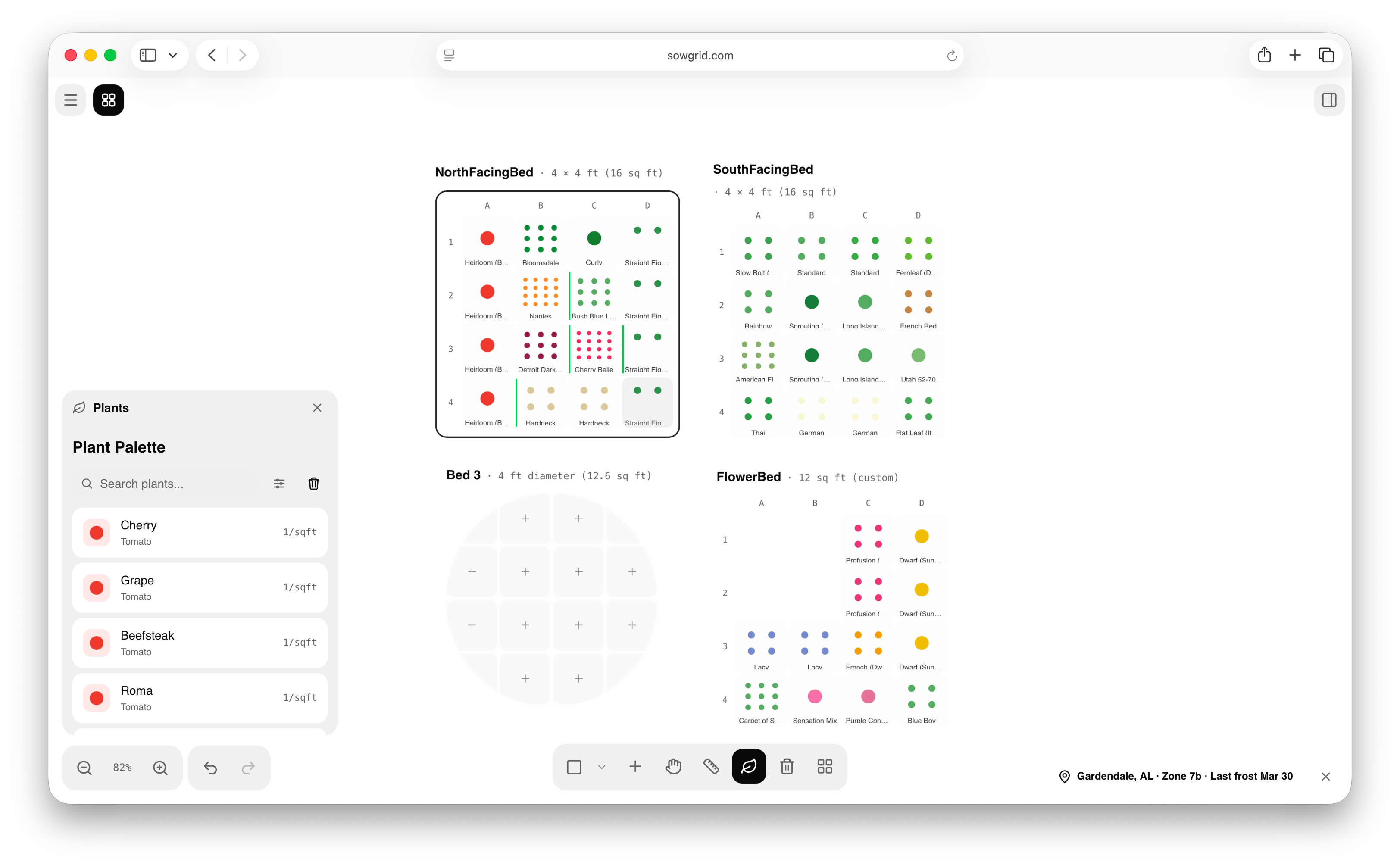
Most gardening apps stop at the layout. You plan your garden, feel good about it, and then have no idea if now is actually the right time to start. That gap between finishing a plan and taking a first action is where beginners give up. Sowgrid closes it by combining three things the app already knows: what's in your grid, where you are, and what today's date is.
Three calls that shaped it
Committed to Square Foot Gardening as the methodology. SFG divides beds into one-foot squares and assigns each plant a density. The rules are simple and well-defined, but more importantly the grid maps directly to a data structure. A 4x8 bed is a 4x8 array. That structure is what makes location-aware advice tractable. Without it, the app can only give generic tips. With it, it knows exactly what you're growing and can reason about it specifically.
Rules-based checklist over AI generation. The instinct was to make everything AI-generated. But the target user is a beginner who will actually follow the advice. Wrong frost dates or a confidently incorrect planting window will cause them to fail their first season and blame the app. Deterministic logic is testable, fast, and doesn't hallucinate. Every output can be verified. The AI layer is still planned, but it comes after the rules-based version has been validated against real user behavior. Trust first, sophistication second.
No backend in V1. Accounts and auth add friction at the exact moment you want a new user to experience the product. The core value is simple: plan your garden, get a checklist. That doesn't require a database. localStorage handles persistence, a .sowgrid file export handles the "I don't want to lose this" case, and the stack stays simple enough to ship. Accounts earn their place in V2 when there's enough value to justify the signup step.
What's next
- User accounts and cloud sync so gardens persist across devices and seasons
- AI assistant with full garden context. It knows your grid, your location, and the date. That's what makes it different from ChatGPT: the context is the product.
- Harvest tracking and succession planting prompts so no square sits empty
Open question: Does the checklist actually change behavior? Do users who see it start sooner, come back mid-season? That's what V2 is built around finding out.
Changelog
Mar 2026 — Companion plant warnings shipped (F6)
Canvas cells now show a colored left border accent when incompatible or compatible plants are placed adjacent. Amber for conflicts, green for good neighbors. Warning detail also surfaces in the List tab under each plant entry. Language kept non-alarmist, using "does not grow well with" rather than flagging hard failures, since most companion planting rules are commonly recommended rather than scientifically proven.
Mar 2026 — V1 shipped
Canvas, plant library, location input, plan-to-sow checklist, companion warnings, and custom plant lookup via Claude API. No backend, no account required. Gardens save to localStorage and export as a .sowgrid file. 205+ plant variants across vegetables, roots, herbs, fruits, and flowers.